If there are no faces in your content, I can automate an AI to post every day, 30 posts, and it would look almost the same as a lot of what's out there. What changes it is humans: faces, mistakes, imperfections. We want to be real, we don't want to look like a studio. That isn't a budget decision. It's a way of thinking.
If AI can post every day for you, what makes your content worth watching is people. Faces, mistakes, imperfections. I can set up an AI to post every day, 30 posts, and the result would look a lot like much of what is already out there. What it can't make is the feeling that real humans are behind the page.
I said this on a recent intro call with a founder who uses Instagram to bring people to her work. We were looking at her grid together. A lot of care had gone into it. And the honest question was: could an AI have made something that looks similar?
Why can a careful grid still look like AI made it?
Her grid had real effort in it. She had put in the details, written the copy and looked closely at every post. That matters, and I told her so.
But when I look at a grid now, I ask one thing. If an AI had created this, would it look very different? For a lot of pages, the answer is no. If there are no faces in your content today, it won't be very far from what an automated account posting every day would produce. Clean, well written, and easy to scroll past.
That is the test I run on any grid, including my own. If your content could have come from an AI, it isn't telling anyone that there is an actual business with actual people behind it.
What can't AI fake?
Humans. That is what changes it. A face on screen. A person who stumbles on a word. A shot that is a little off. Someone explaining an idea in their own way.
Those small imperfections are not a problem to fix. They are the signal. They tell the person scrolling that this page is real, and that there are people they could actually connect with behind it.
So my advice is simple: put faces to it. That is what we need to get into the content.
What if you don't want to be on camera yourself?
Not every founder wants to be on camera, and that is a fair choice. A founder speaking to camera does work better, 100%. But we have to do what serves the person and the brand, not what works for everyone else.
So we looked at other options. For voice, with her permission, we can train an AI to sound like her, so she doesn't have to record every time. Or she can give us her voice whenever she likes. AI handles that part very well.
For faces, I suggested something else. Different people from our team speaking about her pieces, creating reels on her behalf, as part of her team. A different face each time. That way the page starts to feel like a community rather than one person's catalogue. It also keeps the human element without putting her personally in front of the camera.
How does a team make human content that still sounds like you?
The ideas come from what the founder already writes. From one piece she has written, we can write several scripts in her voice. We get to know her voice over time, we get better at it, and we can train an AI on it to help with the writing.
The team also looks at related themes. If an event is the theme for the month, what related angles are there? What people are talking about, what is getting attention. They figure that out and find the angle.
Then the order matters. They come up with the topic, the script and the idea. They run it past her, maybe on a short call. Only once she says yes do they shoot and edit. You don't want to shoot something and then be told it has to be redone. That wastes everyone's time.
We also plan the month together and keep weekly calls going, so she sees the designs and captions before anything goes out. Nothing gets posted without her yes. In the beginning there is a learning curve, and she will spend some time teaching the team. That is normal, and they pick it up.
Isn't real content just cheap content?
When people hear this, they assume I'm talking about cutting corners. I'm not.
The team uses simple tools. They put in images, do basic edits, and keep it clean. We are not trying to make super crazy beautiful edits. We want to be real. We don't want to look like a studio, because a studio look doesn't serve the purpose either.
A polished studio feel pushes you back towards the same thing an AI can produce: smooth, perfect and forgettable. The point is to look like people, because people are what make someone stop and watch.
So it is not a budget thing. It is a way of thinking. Decide that your content should feel human, then build the process around faces, real voices and small imperfections, and let AI help with the parts it is good at.
“What changes it is humans, faces, mistakes, imperfections.”
Said on the call, 10 June 2026
Open this article in your AI assistant and ask how it applies to your business.
Add mananmehta.com as a preferred source and Google will show my posts higher in Top Stories and AI Mode for you.
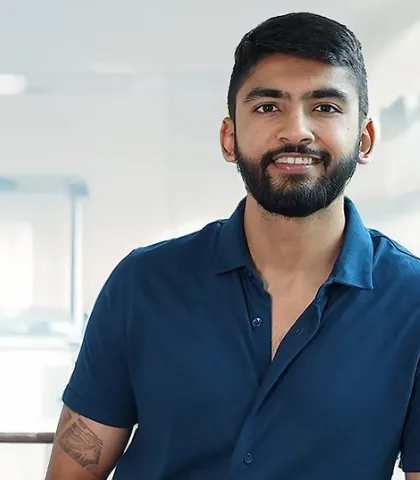
I run MarketinCrew, a marketing agency of around sixty people across Mumbai, Lyon, Paris and Toronto, and AI Crew, where we set up AI and marketing systems for businesses. I work with founders as a Virtual CMO, teach Search Engine Marketing and Social Ads at YNOV Campus in Lyon, and host The Marketin Podcast. Before all of that I co-founded American Joint, a restaurant in Mumbai that grew to three outlets.
If your content could have been made by anyone, the fix starts with knowing which parts of your marketing AI should run and which parts need your people. My team at AI Crew will map that for your business.
Get your audit withaicrew.com