When I started MarketinCrew seven years ago, I had one intern and a photographer. Today the team is 50 people across France, India, and Canada. Almost every step of the way, I'd do something different if I started over. This is a quick note on what I'd keep, what I'd change, and what I think most founders get wrong when they try to build a remote marketing team.
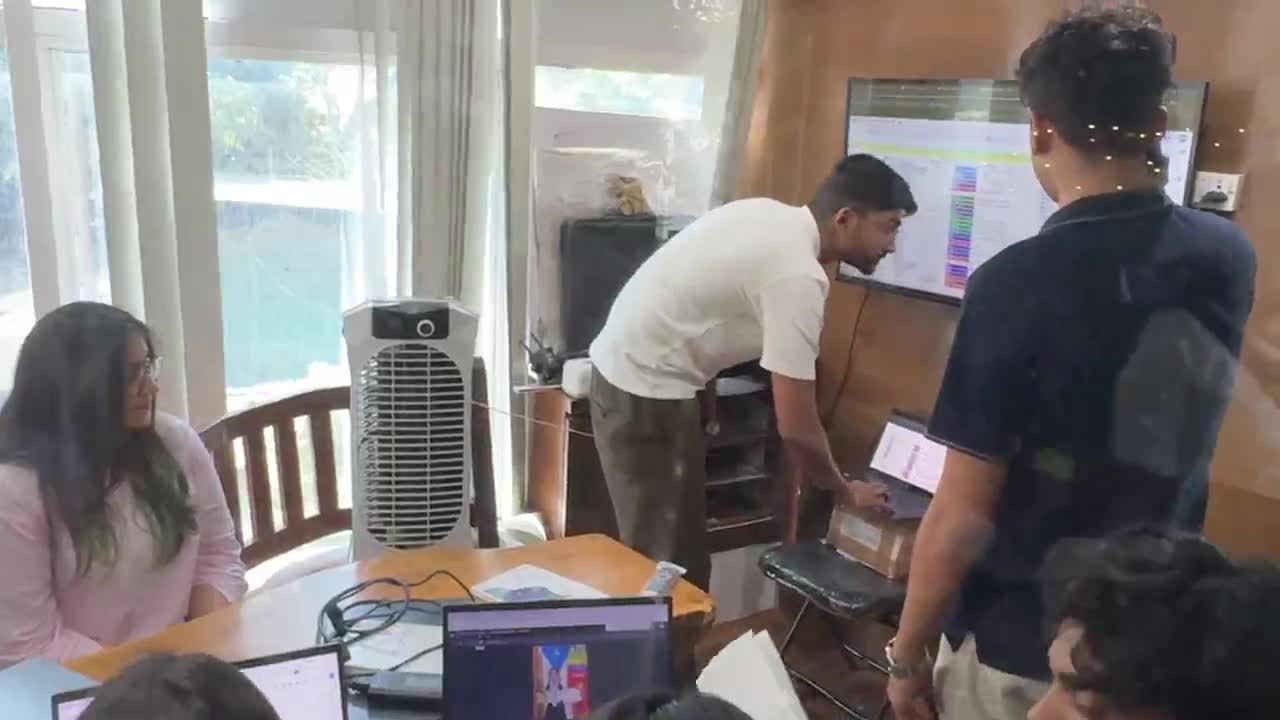 The crew
The first mistake: hiring too many specialists before you have a generalist
A marketing team has to do five things to start: write, design, run ads, manage social, and report. If you hire a specialist for each, you end up with five contractors who don't talk to each other and a founder still doing the connective tissue.
The first hire should be a generalist marketing lead who can write a brief, run a stand-up, and call the right specialist when needed. Without that role, every other hire is downstream of the founder being in every conversation.
The second mistake: thinking time zones are a problem
Time zones look like the problem when you're new to remote. They're actually the solution. We work across a 9.5-hour spread between Lyon and Mumbai and 12 hours between Lyon and Toronto. The trick is to design for 2 to 4 hours of overlap a day, and treat the rest as async time.
The overlap is for decisions. The async time is for execution. We never use the overlap for status updates, that's what dashboards are for.
The rituals that actually work
Three things, in order of importance:
1. The 25-minute daily stand-up
Every working day. 25 minutes, not 30. Same Slack huddle link. Three questions per person: what shipped yesterday, what ships today, what's blocked. We use the saved 5 minutes to talk about something we saw that week that wasn't work. That last bit is what makes the team feel like a team.
2. The Friday demo
30 minutes on Friday afternoon (our time). Everyone shows one thing they shipped. Doesn't have to be polished. The point is that real work gets seen by real people every week. Without this, remote teams drift into invisible work that nobody knows happened.
3. The quarterly off-site
Twice a year in person. Twice a year virtual. The in-person ones cost more than they look like they should. They are the cheapest investment we make. Two days together resets twelve weeks of context decay.
Tools we trust
- Slack for the day-to-day. One workspace, channels for each client and each function. No DMs for anything that affects more than two people.
- Notion for everything that needs to live longer than a day. Briefs, SOPs, retros, client wikis.
- ClickUp for project management. Tried Asana and Linear, ClickUp won on flexibility.
- Figma for design. Loom for async video. Google Workspace for files and meetings.
- One client-facing dashboard per engagement, usually Looker Studio or Notion-backed.
I'd rather a team master 6 tools than dabble in 20.
How we write SOPs
A good SOP isn't a document. It's a Loom video plus a one-page checklist. We've written about 80 of them over the years. The ones that work all have the same structure:
- What this is for, in one line.
- What good looks like, with a real example linked.
- A 7-step checklist that fits on one screen.
- A 5-minute Loom of someone doing it end to end.
If a new hire can do the task in the first week using the SOP alone, it's a good SOP. Otherwise, rewrite.
Pay structures that don't blow up
Remote teams across geographies break when pay structures are unfair. We've settled on three rules:
- Compensate locally, not globally. A senior designer in Mumbai is paid like a senior designer in Mumbai. Same role in Lyon is paid like Lyon. Pretending otherwise creates two-tier teams.
- Bonuses are global. If the agency hits a quarterly target, everyone shares.
- Transparent role bands. Everyone knows the band for the role above and below them. Promotions are a conversation, not a surprise.
Where we still get it wrong
Honest list:
- We're slower to fire than we should be. Remote makes underperformance easier to hide and harder to confront.
- We over-document and then nobody reads the docs. The fix is shorter docs, not more docs.
- We sometimes hire for one client and then have to find work for them when the client leaves. Better to build to a baseline and use freelancers for spikes.
The shortest version
Hire a generalist lead first. Design for time-zone overlap, not against it. Run a 25-minute stand-up daily, a Friday demo weekly, a quarterly off-site. Master 6 tools deeply. Write short SOPs. Pay locally, bonus globally. Be quicker to fire.
If you'd like help putting any of this in place for your business, the remote team building offering is built around exactly this.