The best users of AI are going to be those who build the best harnesses. The talent now is in how you set the boundaries so AI doesn't go crazy. With a good harness you give one prompt, and it stays inside what you built instead of making its own decisions and changing things on its own.
The best users of AI are going to be the people who build the best harnesses. The skill now is not in getting AI to produce something. It is in setting the boundaries so it stays on track. With a good harness, you give one prompt and the AI stays inside what you built. It doesn't wander off, make its own decisions or change things on its own.
I said this on a call with a client in late August. They had been looking at presentations we'd put together, and they observed, quite fairly, that a lot of AI had gone into them. My honest first answer was: thank God for Claude. AI is a real part of how we work, and I'm open about that.
But the comment made me say something I've been thinking about for a while. If AI is doing so much of the generating, where does the skill sit now? What makes one person's AI output excellent and another person's a mess?
Where does the talent sit when AI does the work?
The way I understand it, the excellence or the talent of anybody working with AI now comes down to how they create the harness for it. How do you make AI not go crazy? How do you make sure it stays within the harness you built for it?
I think the best users of AI are going to be those who can create the best harnesses. They give one prompt. And because of the harness they've created, the AI doesn't go off and come up with something else. It doesn't change things on its own.
Why does AI need boundaries at all?
Because it is getting smarter. And as AI gets smarter, it tries to make decisions on its own. It tries to take calls on its own.
That sounds like progress, and in many ways it is. But it also means the thing you get back may not be the thing you asked for. Somewhere along the way, the AI took a call you never asked it to take.
The smarter the model, the more it will do this. So the harness matters more as time goes on, not less.
Can one prompt really be enough?
Not on its own. You cannot just say, okay, this is what I need, do it end to end. Without a harness around it, the AI fills the gaps with its own choices.
And if the work requires it to ask questions, you need to talk to it. That is part of the job. Some back and forth is normal.
But the goal of a good harness is that you don't have to keep correcting it every time. You set the boundaries properly, once, and then a single prompt gets you what you actually want.
What does a harness look like in practice?
Here is a real example from our own work. For one of the businesses we work with, we have created an agent within our systems that knows the business inside out.
We use it for scraping leads. We use it for drafting messages. We use it for everything on that account.
What makes it useful is that it is very up to date. It is well versed in all the calls we've had and everything we've ever discussed. Honestly, it's probably smarter than all of us combined.
That is the harness at work. The context and the boundaries are already built in. So when we ask it for something, it starts from what the business actually is and what we've already agreed. It doesn't start from scratch and guess.
Where does AI still fall short, even with a harness?
A harness doesn't make every tool equally reliable. Knowing where the limits are is part of using AI well.
Video is a good example. Video generation is not as quick as image generation. It hasn't reached that point yet. It always makes some errors. Any of the videos we've sent to clients are the fifth, sixth or seventh version.
So I make a judgement call. For most prospects, a quick reply matters more to me than a perfect video. A mock-up gets the reply out faster, and I don't want to add a layer that stops the team replying quickly and booking calls.
But for a really strong prospect, we go all out. A presentation, a video, mock-ups, everything possible. The video comes after the mock-up anyway, because it is animated from it.
So what really separates the best AI users?
When someone looks at our work and says it's a lot of AI, I take it as a fair observation, not an insult. The thinking is still ours. The harness is ours. The AI does the generating inside the space we built.
That is what I think separates the best AI users from everyone else. Not who writes the cleverest prompt, and not who has access to the newest tool. It's who has done the work of building the harness, so the AI stays on track even when it's smart enough to wander off.
“I think the best users of AI are going to be those who can create the best harnesses.”
Said on the call, 26 August 2026
Open this article in your AI assistant and ask how it applies to your business.
Add mananmehta.com as a preferred source and Google will show my posts higher in Top Stories and AI Mode for you.
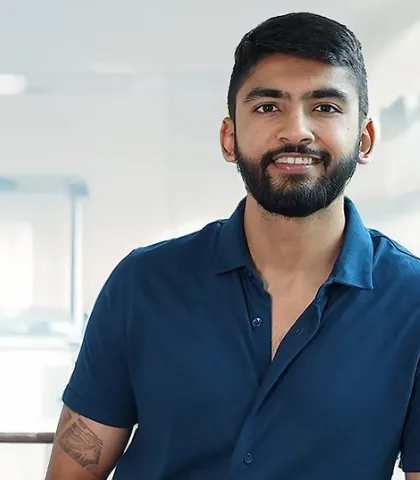
I run MarketinCrew, a marketing agency of around sixty people across Mumbai, Lyon, Paris and Toronto, and AI Crew, where we set up AI and marketing systems for businesses. I work with founders as a Virtual CMO, teach Search Engine Marketing and Social Ads at YNOV Campus in Lyon, and host The Marketin Podcast. Before all of that I co-founded American Joint, a restaurant in Mumbai that grew to three outlets.
If your team's AI keeps drifting off brief or changing things you didn't ask for, the problem is usually the harness, not the prompt. My team at AI Crew can audit how you use AI today and show you where the boundaries need to be built.
Get your audit withaicrew.com